

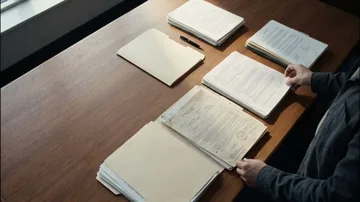






The aerospace quality engineer’s daily cross-check
In aerospace, a part is only as good as the documents that prove it. A quality engineer constantly checks that the drawing, the specifications it calls up, the material and process certifications, and the inspection results all agree. When they do not, the problem is often found late, at first article inspection or by the customer.
First article inspection under AS9102 is where these mismatches surface most clearly. A guide from GD&T and inspection specialist GNDCTL lists the most frequent failure as inconsistency across the three FAI forms, such as mismatched part numbers, revisions or FAIR IDs, followed by certificates to outdated specification revisions and missing flagged characteristics (GNDCTL).
The document chain to check
| Link | What must agree | Typical mismatch |
|---|---|---|
| Drawing ↔ specification | Spec numbers and revisions called on the drawing | Drawing updated, spec revision not |
| Specification ↔ certificate | Material and process certs to the right spec revision | Cert to an older revision |
| Certificate ↔ supplier approval | Special process supplier approved by the customer | Supplier holds an accreditation but is not customer-approved |
| Drawing ↔ ballooned characteristics | Every dimension, note and GD&T frame ballooned once | Notes and flag notes missed |
| Balloons ↔ inspection results | One result row per characteristic, actual values | ”Pass” recorded instead of measured values |
| Part identity across records | Part number, revision and FAIR ID consistent | Form 1 and Form 3 show different revisions |
GNDCTL notes that reviewers should confirm special-process suppliers are customer-approved, observing that Nadcap alone is not enough, and that every certificate row should have a real certificate number rather than “on file”.
When to re-check: changes
A new or delta FAI is needed when a design, process, tooling or location change affects fit, form or function, and may be required after a production lapse if the customer specifies it (GNDCTL). For a quality engineer, every engineering change should trigger a cross-check of the document chain, not just the drawing.
What the next AS9100 revision may add
The IAQG is revising AS9100 under a new “IA” prefix as IA9100. Timing estimates differ: NASA reported a Q4 2026 target in April 2024 (NASA), CVG Strategy expected release in 2026 with a transition likely until 2029 (CVG Strategy), and BSI expects the series in early 2027 after the ISO 9001 revision (BSI).
Themes identified in the drafting, as reported by NASA, include APQP, product safety, human factors, cyber and information security, counterfeit terminology, foreign object debris, sub-tier supplier control and transfer of work. CVG Strategy also reports a stronger emphasis on data-driven process validation. For quality engineers, sub-tier control and process validation are the themes most likely to add document checks.
A practical routine
- On every drawing revision: re-check spec callouts and open FAIs.
- On every certificate received: check spec revision and supplier approval status.
- Before every FAI review: reconcile balloon count to Form 3 rows and part identity across forms.
- Monthly: sample closed FAIRs for consistency errors and feed findings back to inspectors and suppliers.
Who you work with
- Design engineering: drawings and changes.
- Materials and processes engineering: specifications and special processes.
- Supplier quality: supplier approvals and certificates.
- Inspection: FAI and in-process records.
- Customer quality representatives: approvals and escalations.
Common weaknesses
- Spec revisions not checked when certificates arrive.
- Special process suppliers assumed approved because they are accredited.
- Drawing notes not ballooned.
- Engineering changes released without re-checking FAI status.
- Cross-checks done by memory instead of a checklist.
Checklist
- Document chain mapped for each part family
- Certificate checks include spec revision and supplier approval
- Balloon count reconciled to inspection records
- Change process triggers FAI review
- Monthly consistency sample of closed FAIRs
- IA9100 revision on watch list
How AskDona helps
Cross-checking drawings, specifications, certificates and inspection records is exactly the reading work that slows quality engineers down. AskDona reads those documents together and flags mismatches in part numbers, revisions, specification callouts and supplier approvals, with citations to each page. Run a sample drawing-to-record cross-check on one part. AskDona shows the evidence; your quality engineers decide.
Editor’s note: AS9100 and AS9102 texts are copyrighted and not reproduced; FAI practice is summarized from an industry guide. IA9100 timing and content are not final and sources disagree. The LinkedIn count was supplied by the client.
FAQ
What is the most common FAI error? Inconsistency across the three AS9102 forms, such as mismatched part numbers or revisions.
Is Nadcap accreditation enough for special processes? Not by itself; the special process supplier must also be approved by the customer.
When is AS9100 being revised? As IA9100, with estimates from late 2026 to early 2027.
When does a change require a new FAI? When a design, process, tooling or location change affects fit, form or function.
References
All pages opened and checked by October 23, 2026.
| Source | Type | Used for |
|---|---|---|
| GNDCTL: How to fill out AS9102 forms (updated Oct 14, 2026) | Industry guide | FAI errors, cross-checks, change triggers |
| NASA: Status of IA9100 development (Apr 17, 2024) | Government agency | Revision themes, timing |
| CVG Strategy: IA9100 series standards (Nov 7, 2025) | Consultancy | Timing, process validation |
| BSI: Embracing changes to IAQG aerospace standards | Certification body | Timing |